January 24, 2025

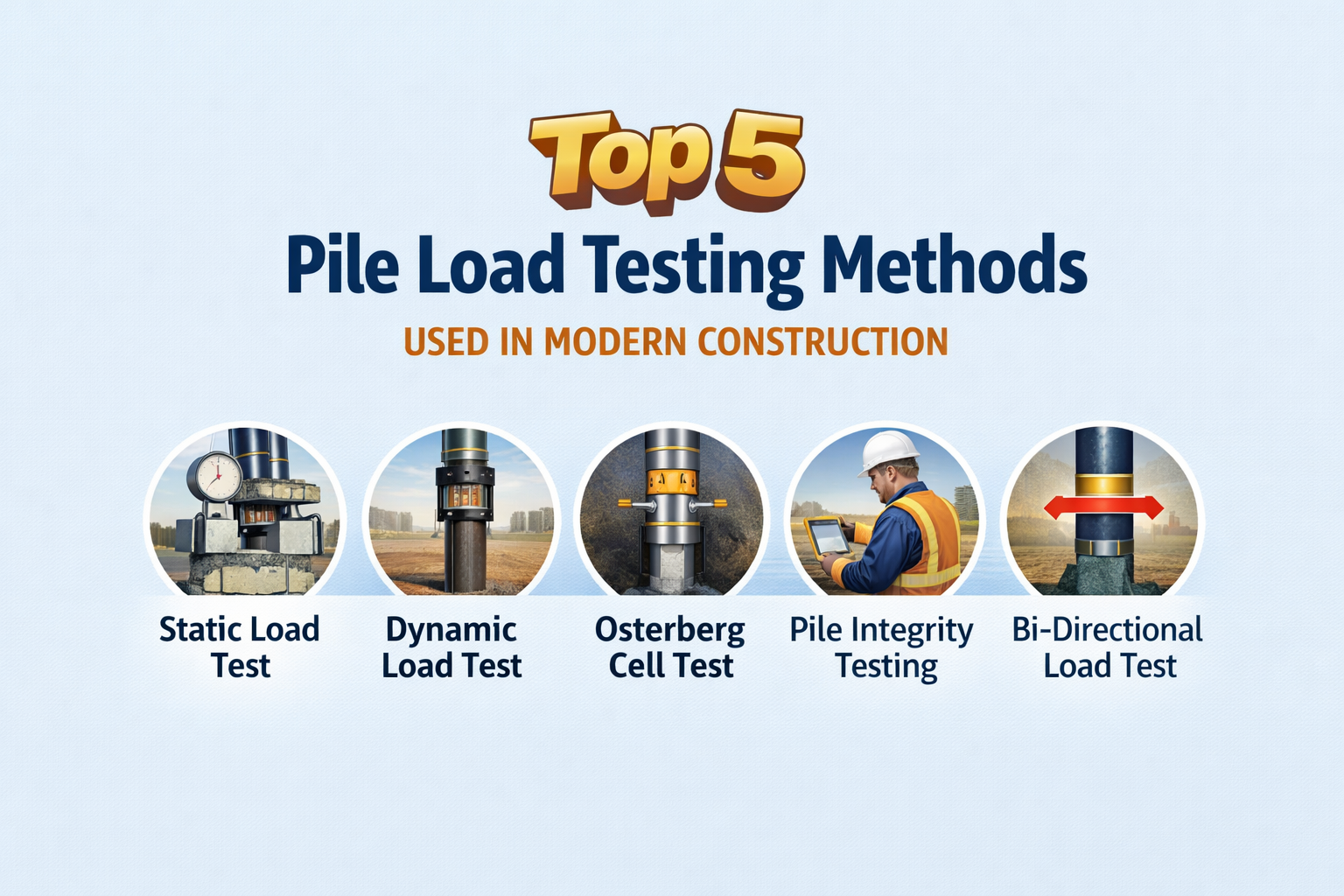
Top 5 Pile Load Testing Methods Used in Modern Construction
When we construct a building, bridge, or any heavy structure, the foundation must be strong enough to carry the entire load. Piles are deep foundation elements that transfer the weight of a structure to the deeper, stronger layers of soil or rock. But how do engineers confirm that these piles are safe and capable? The answer is — pile load testing.
Pile load testing is a critical process in pile foundation testing that helps engineers verify the bearing capacity, integrity, and performance of piles before the actual construction begins. Without proper load test on pile, there is always a risk of foundation failure, which can lead to disasters.
In this blog, we will explore the top 5 pile load testing methods used in modern construction, explained in simple language so that anyone can understand.
Why is Pile Load Testing Important?
Before we jump into the types of pile load testing, let us understand why it matters:
-
It confirms that the pile can safely carry the designed load.
-
It helps detect any defects or weak zones inside the pile.
-
It reduces the risk of foundation failure in large projects.
-
It is required by Indian Standards (IS Code) and international codes before major construction.
-
It saves money in the long run by avoiding costly repairs or rebuilding.
Pile load testing in construction projects is not optional — it is a necessity for safe and reliable structures.
Method 1: Static Pile Load Test
The static pile load test is the oldest and most trusted method of pile load testing. In this method, a heavy load is applied slowly on top of the pile using hydraulic jacks, and the settlement (downward movement) of the pile is measured at each load increment.
How it works:
-
A reaction system is set up around the test pile.
-
Load is applied in stages using a hydraulic jack.
-
Settlement is recorded at each load stage.
-
The test continues until the pile reaches its maximum capacity or fails.
Advantages:
-
Very accurate and reliable results.
-
Directly measures the pile capacity.
-
Widely accepted by all codes including IS code.
Limitation:
-
It is time-consuming and expensive.
-
Requires heavy equipment and setup.
The static pile load test is the gold standard in pile load testing procedure step by step and is commonly used for high-rise buildings, bridges, and critical infrastructure.
Method 2: Dynamic Load Testing of Piles (High Strain Dynamic Testing)
Dynamic load testing of piles is a modern and faster alternative to static testing. In this method, a heavy hammer drop is used to strike the top of the pile, and sensors attached to the pile measure the force and velocity during the impact.
This is also called high strain dynamic testing because the impact creates a high level of strain in the pile.
How it works:
-
Strain gauges and accelerometers are attached near the pile head.
-
A drop hammer strikes the pile with controlled force.
-
Data is recorded and analyzed using software like CAPWAP.
-
The pile capacity is calculated from the wave response data.
Advantages:
-
Much faster than static testing — results in hours.
-
Can test multiple piles in a single day.
-
Also detects pile integrity (cracks or defects).
PDA test pile foundation (Pile Driving Analyzer) is the most popular tool used in this method.
Method 3: Low Strain Pile Integrity Test
The low strain pile integrity test is used to check the quality and continuity of a pile, not its load capacity. It is a non-destructive test method, meaning it does not damage the pile.
How it works:
-
A small hand-held hammer is used to lightly tap the pile head.
-
A sensor records the stress wave traveling down the pile.
-
Reflections from defects, cracks, or pile toe are analyzed.
Advantages:
-
Very fast and economical.
-
Can test a large number of piles in one day.
-
Ideal for checking pile integrity after installation.
This method is one of the most used pile integrity testing methods on construction sites across India and worldwide. It is especially useful when there is doubt about the concrete quality or installation process.
Method 4: Bi-Directional Pile Load Test (Osterberg Cell Test)
The bi-directional pile load test, also known as the Osterberg cell test (O-cell test), is an advanced and innovative pile testing method. It is mostly used for large-diameter bored piles and piles in deep water or offshore projects.
How it works:
-
A specially designed hydraulic cell (O-cell) is placed inside the pile during installation.
-
When the test is conducted, the O-cell expands and pushes the pile in two directions — upward and downward.
-
This measures both the shaft friction and the end-bearing capacity separately.
Advantages:
-
No need for external reaction system.
-
Can test very high load capacities.
-
Very useful for bridge piers, metro rail projects, and large foundations.
The difference between static and dynamic pile load test is clear here — bi-directional test gives much more detailed data on pile behavior at great depths.
Method 5: Rapid Load Test (Statnamic Test)
The Rapid Load Test, commonly called the Statnamic Test, is a method between static and dynamic testing. A controlled combustion device is placed on top of the pile, and a slow but forceful push is applied — slower than dynamic testing but faster than static testing.
How it works:
-
A Statnamic device is placed on the pile head.
-
Combustion gases generate a pushing force on the pile.
-
Force and displacement are measured.
-
Results are analyzed to determine pile capacity.
Advantages:
-
Faster and cheaper than static load test.
-
Suitable for testing in water or difficult-to-access locations.
-
Gives reliable pile capacity results.
This method is gaining popularity in pile load testing in construction projects involving marine structures, jetties, and offshore foundations.
Pile Load Testing as Per IS Code
In India, pile load testing as per IS code is governed by IS 2911 (Part 4) which provides detailed guidelines for conducting load tests on piles. The code specifies the test procedure, loading cycles, acceptance criteria, and the minimum number of piles to be tested on a project.
Every contractor and structural engineer must follow IS 2911 standards to ensure safety and compliance in pile foundation testing.
How to Perform a Pile Load Test — Quick Summary
If you are wondering how to perform a pile load test, here is a simple overview:
-
Select the test pile based on project requirements.
-
Choose the right testing method (static, dynamic, or integrity test).
-
Set up equipment — jacks, sensors, reaction system.
-
Apply load in stages and record measurements.
-
Analyze results and compare with design pile capacity.
-
Prepare a test report and submit to the structural engineer.
Conclusion
Pile load testing is one of the most important steps in building a safe and durable foundation. Whether you use the traditional static pile load test, the fast dynamic load testing of piles, the non-destructive low strain pile integrity test, the advanced Osterberg cell test, or the modern Statnamic test — each method has its own importance and use case.
Understanding the types of pile load testing helps engineers, contractors, and project owners make the right decision for their specific construction needs. Always ensure that pile load testing is done by experienced professionals following proper codes and standards.
If you need expert pile load testing services for your construction project, feel free to contact us today!
Popular post


February 08, 2025
Pile Load Testing: Importance, Methods, and Benefits

February 11, 2025
Piling Work Service: The Key to Strong and Stable Foundations

February 18, 2025
What Are Geotechnical Services? A Complete Guide


February 22, 2025
What is a Road Safety Audit & Why is it Important?







April 16, 2025
Types of Material Testing: A Complete Guide for Beginners






February 07, 2026
Top 10 Geotechnical Problems in Construction and Their Solutions




June 30, 2026
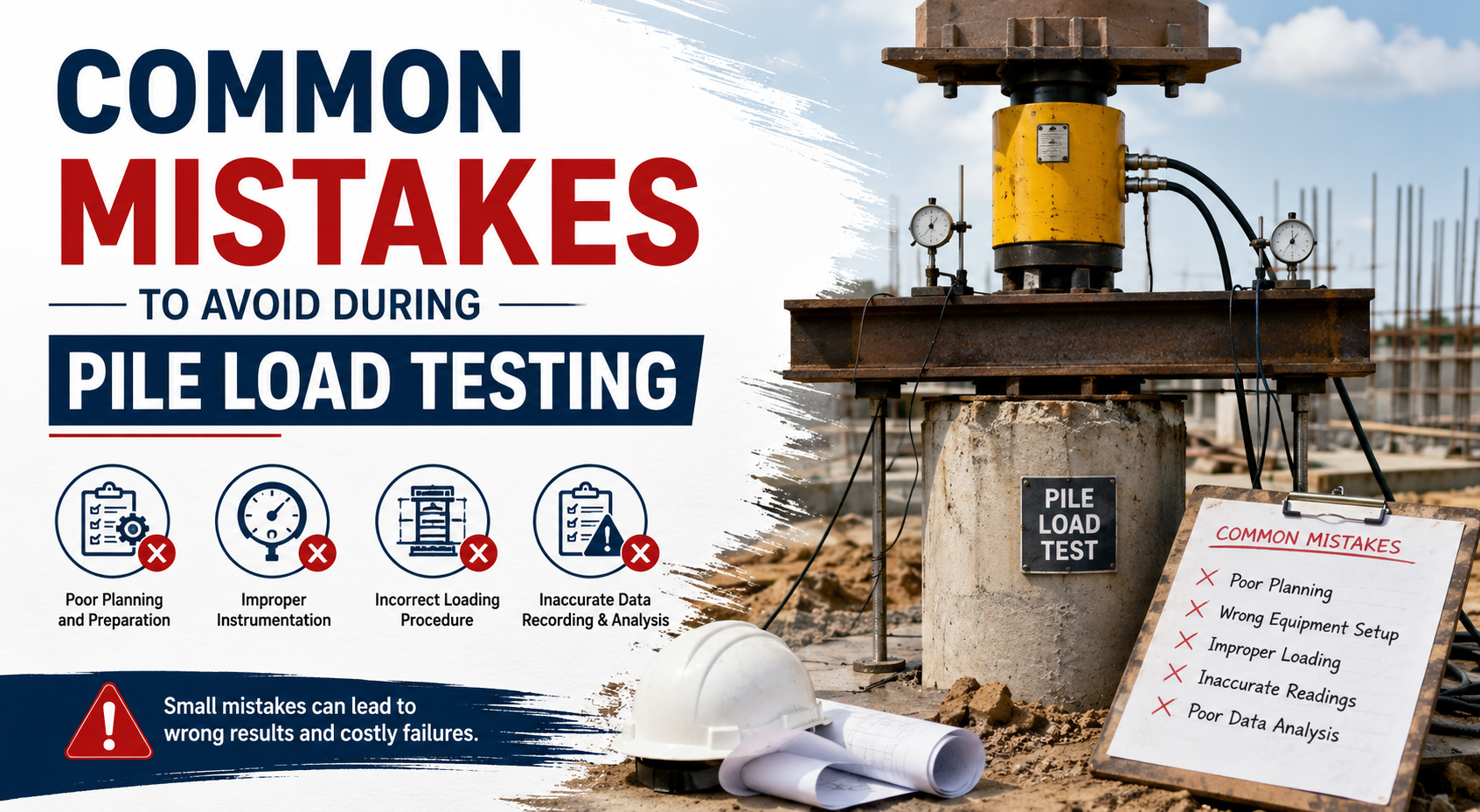
Common Mistakes to Avoid During Pile Load Testing

Need help? Call us Today at+91 7665235528
for inquiries and support. We’re here to assist you.