January 24, 2025

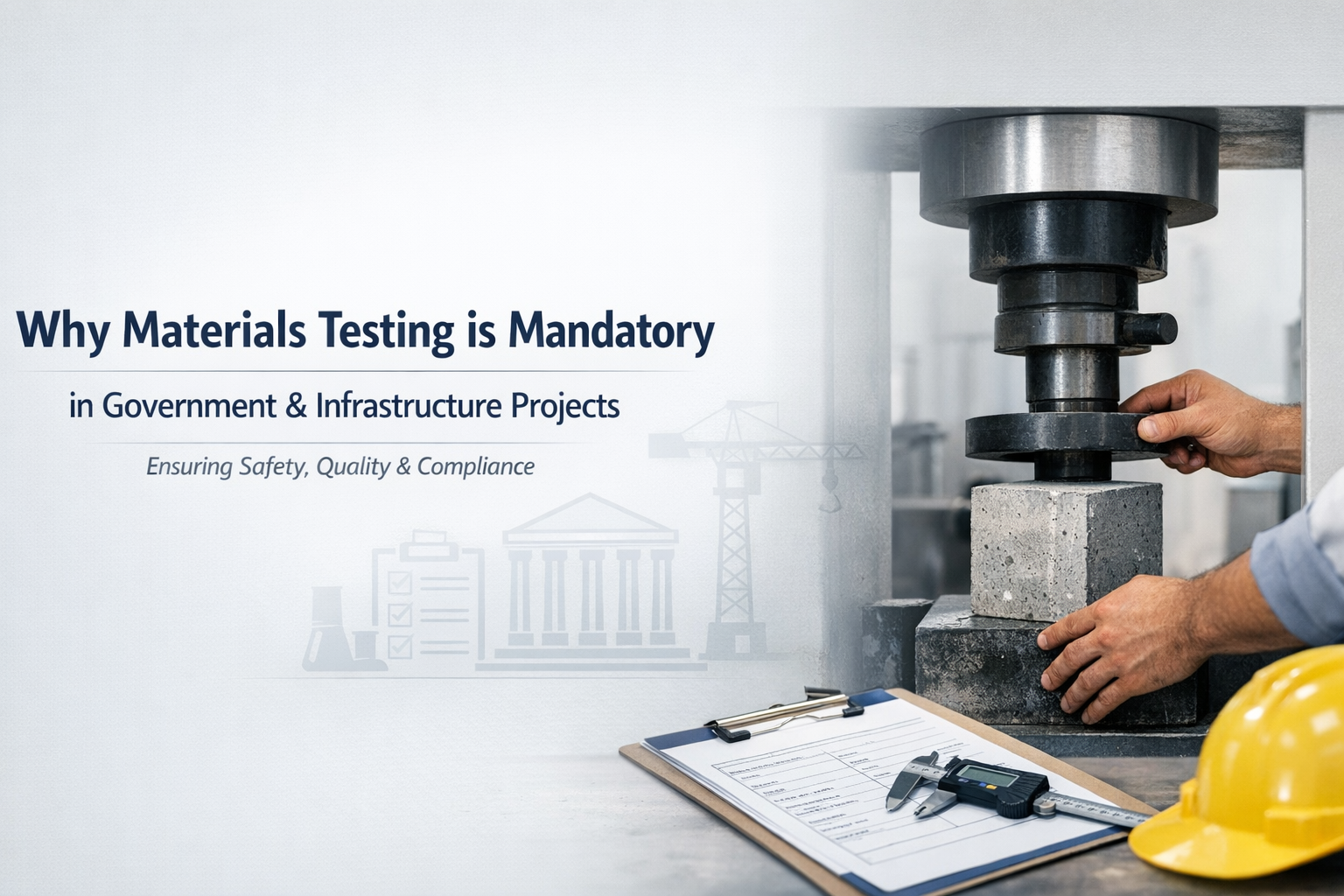
Why Materials Testing is Mandatory in Government and Infrastructure Projects
When a government builds a road, bridge, dam, or public building, millions — sometimes billions — of rupees of public money are at stake. More importantly, the safety of thousands of citizens depends on the quality of every material that goes into that structure. This is why mandatory materials testing in construction is not just a bureaucratic requirement — it is a fundamental pillar of responsible infrastructure development.
In India, as infrastructure investment grows rapidly under programs like PM Gati Shakti and Smart Cities Mission, the role of material testing in government projects has never been more critical. Whether it is a national highway in Rajasthan or a metro rail project in a major city, no government project can proceed without rigorous testing and quality verification.
1. What is Materials Testing in Construction?
Materials testing in construction refers to a series of scientific and engineering tests performed on raw materials — such as soil, concrete, steel, asphalt, aggregates, and cement — to verify that they meet the required quality standards before and during construction. The civil engineering material testing process ensures that no substandard material is used, which could lead to structural failure, safety hazards, or costly repairs in the future.
These tests are carried out by accredited laboratories and qualified engineers following strict procedures defined by national and international codes. In India, the primary authority governing these standards is the Bureau of Indian Standards (BIS) and the IS Codes (Indian Standards) issued for different types of construction materials.
Key Materials That Are Tested:
-
Soil — for bearing capacity, compaction, moisture content
-
Concrete — for compressive strength, workability, durability
-
Steel reinforcement bars — for tensile strength, elongation, bend test
-
Asphalt & bitumen — for road construction quality
-
Aggregates (sand, gravel, stone) — for gradation, hardness, cleanliness
-
Cement — for initial/final setting time and consistency
2. Why is Materials Testing Mandatory in Government Projects?
Government projects are funded by taxpayers and serve the public. Unlike private construction, there is zero tolerance for substandard quality in public infrastructure. Mandatory materials testing construction requirements exist for several critical reasons:
A. Legal and Regulatory Compliance
All government tenders and contracts in India include specific clauses requiring third-party material testing and quality control reports. Agencies like the Central Public Works Department (CPWD), National Highways Authority of India (NHAI), and state PWDs follow strict quality assurance protocols. Failing to comply with testing requirements can result in contract termination, legal action, and financial penalties.
The Bureau of Indian Standards (BIS) — bis.gov.in — has published comprehensive IS codes covering every aspect of construction material testing, and government projects must adhere to these mandatorily.
B. Structural Safety and Public Protection
Poor quality materials are one of the leading causes of structural failures in India. Bridges collapsing, roads developing potholes within months, and buildings becoming unsafe — many of these tragedies trace back to the use of substandard materials. Quality control in infrastructure projects through systematic testing eliminates this risk at the source.
According to government reports, a significant percentage of infrastructure project failures in India are directly linked to material quality issues that could have been caught through proper testing.
C. Financial Accountability
Infrastructure project quality testing is also a tool of financial accountability. It ensures that the materials contractors are being paid for — the grade of steel, the mix design of concrete, the quality of aggregate — are actually being delivered. Without testing, contractors can use cheaper, substandard materials while billing for premium grades, causing massive financial losses to the government.
D. Long-Term Durability and Life Cycle Cost
A road or bridge built with properly tested materials will last decades with minimal maintenance. One built with inferior materials may fail within a few years. Infrastructure project quality testing is an investment that saves enormous amounts of money over the life of the structure. Government agencies now increasingly evaluate life cycle costs rather than just upfront construction costs, making materials testing even more essential.
3. Key IS Codes and BIS Standards for Construction Material Testing
India has a well-established framework of construction material testing standards. BIS standards for construction materials are codified into IS Codes that specify the exact testing procedures, acceptable limits, and frequency of tests. Some of the most important IS Codes include:
|
IS Code |
Material / Test |
Application |
|
IS 456:2000 |
Plain & Reinforced Concrete |
All concrete structures |
|
IS 2386:1963 |
Aggregate Testing |
Roads, buildings, dams |
|
IS 2720:1983 |
Soil Testing Methods |
Foundations, embankments |
|
IS 1786:2008 |
Steel Reinforcement Bars (TMT) |
Bridges, buildings, flyovers |
|
IS 4031:1988 |
Cement Testing Methods |
All cement-based construction |
|
IS 1888:1982 |
Plate Load Test for Soil |
Foundation design |
|
MoRTH Specifications |
Road & Highway Materials |
National & state highways |
These IS codes for material testing are not optional guidelines — they are mandatory requirements referenced in all government project tenders and contracts.
4. The Civil Engineering Material Testing Process — Step by Step
Understanding how the material testing process works helps project owners and contractors plan their projects efficiently. Here is the standard civil engineering material testing process followed in government infrastructure projects:
Step 1 — Pre-Construction Phase: Soil Testing for Government Construction
Before a single brick is laid, soil testing for government construction projects is conducted. This includes soil bearing capacity tests, compaction tests (Proctor Test), California Bearing Ratio (CBR) tests for roads, and permeability tests. These results directly influence the foundation design and are submitted to government authorities for approval.
Step 2 — Material Approval Stage: Checking Incoming Materials
Before any construction material is used on a government site, samples are collected and sent to an accredited laboratory. This applies to cement, steel, aggregates, sand, and admixtures. Only materials that pass the required tests receive approval for use on site.
Step 3 — During Construction: Concrete Testing Standards India
Concrete testing standards India requires are among the most rigorous. Cube samples are cast at regular intervals during concrete pouring and tested for compressive strength at 7 days and 28 days. Slump tests are conducted on-site for workability. This ensures every batch of concrete meets the design specification.
Step 4 — Post-Construction Verification: Non-Destructive Testing (NDT)
After construction, non-destructive testing methods such as rebound hammer tests, ultrasonic pulse velocity (UPV) tests, and core cutting are used to verify the in-situ strength of concrete structures without damaging them. These tests are increasingly required for government handover certifications.
Step 5 — Documentation and Reporting
Every test result must be properly documented in test reports, signed by certified engineers, and submitted to the relevant government authority. These records form the quality assurance file for the project and are subject to audit at any time.
5. Role of Third-Party Material Testing Services
Government projects in India increasingly require third-party material testing services — independent laboratories that have no financial interest in the contractor's project outcome. The logic is simple: a contractor should not be the only one verifying the quality of their own work.
Third-party testing provides:
-
Unbiased, independent quality assessment
-
Credibility and transparency in project execution
-
Legal protection for project owners in case of disputes
-
Confidence for government agencies approving project milestones
-
Early detection of non-conforming materials before large-scale use
Government agencies like CPWD (cpwd.gov.in) specifically require third-party quality audits for projects above certain values, and this requirement is increasingly being extended to state-level infrastructure projects as well.
6. Specific Tests Required in Major Government Project Categories
Road and Highway Projects (NHAI / MoRTH)
-
CBR test for subgrade soil
-
Aggregate impact value and aggregate crushing value tests
-
Bitumen penetration and ductility tests
-
Marshall Stability test for bituminous mix
-
Compaction tests for each layer of road construction
Buildings and Structural Projects (CPWD)
-
Concrete compressive strength (cube testing) at 7 and 28 days
-
Steel tensile strength and elongation test
-
Cement consistency and setting time tests
-
Water absorption test for bricks and blocks
-
Rebound hammer and UPV for in-situ concrete verification
Dams, Embankments, and Earthwork Projects
-
Standard Proctor and modified Proctor compaction tests
-
Grain size analysis and Atterberg limits for soil classification
-
Permeability and consolidation tests for dam foundation analysis
-
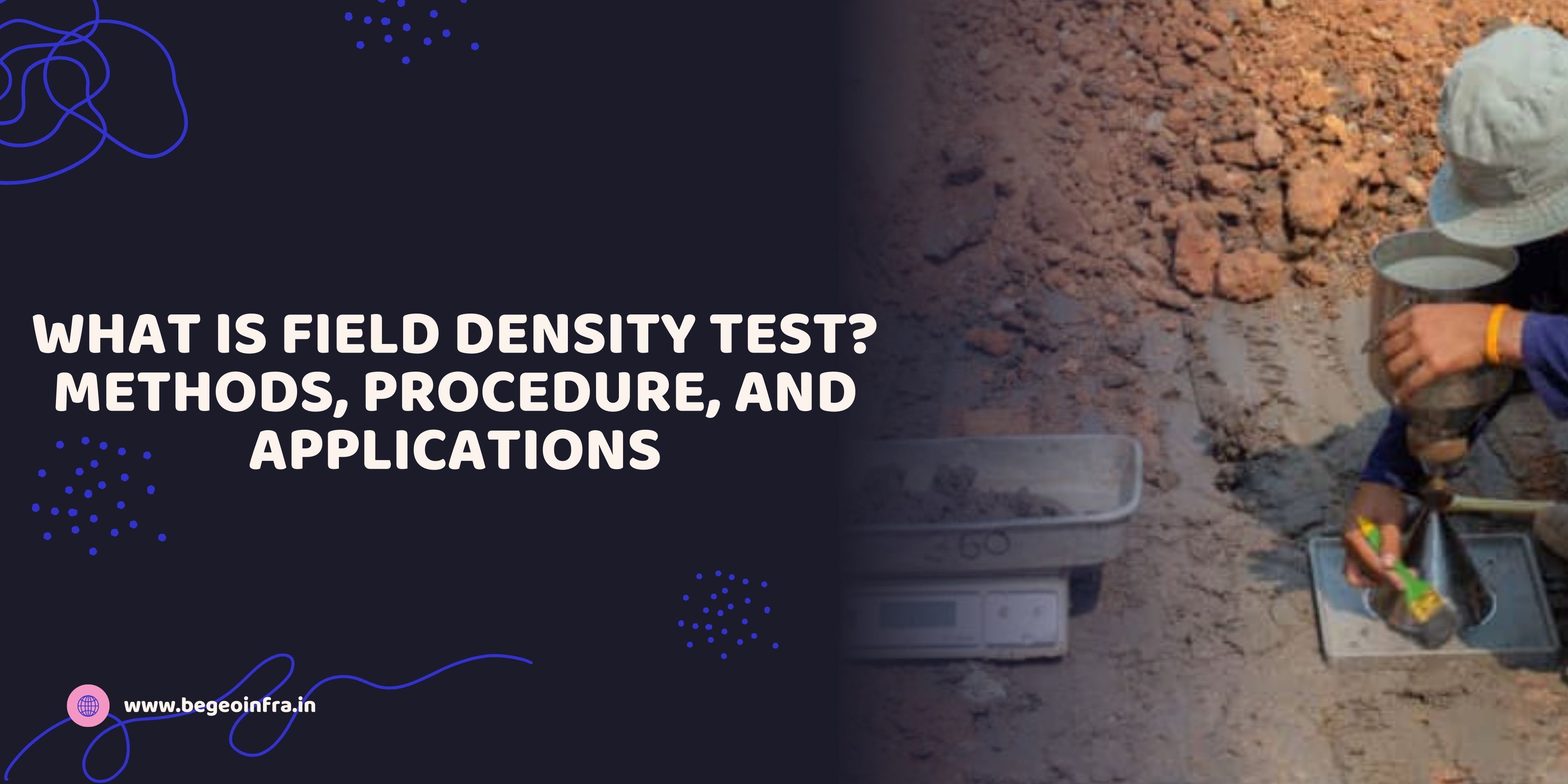
Field density tests (core cutter and sand replacement methods)
7. Consequences of Skipping or Faking Material Testing
The consequences of bypassing mandatory materials testing in construction are severe — both legally and in terms of human safety:
-
Structural failures causing loss of life and property
-
Criminal liability for contractors, engineers, and project managers
-
Cancellation of contractor licenses and blacklisting from government tenders
-
Financial penalties and recovery of project costs
-
Massive reputational damage for all parties involved
-
Projects being demolished and rebuilt at contractor's cost
India has seen several high-profile cases where bridges and buildings collapsed due to substandard materials. These incidents have led to stricter enforcement of quality control in infrastructure projects and increased scrutiny of material testing documentation.
8. Material Testing Service in Jaipur — How BegeoInfra Can Help
If you are working on a government or private infrastructure project in Rajasthan, finding a reliable and accredited material testing service in Jaipur is critical to your project's success and legal compliance.
BegeoInfra offers comprehensive materials testing services in Jaipur and across Rajasthan, covering all aspects of quality control in infrastructure projects. Our team of experienced civil engineers and geotechnical specialists provides:
-
Complete soil testing for government construction projects
-
Concrete cube testing and concrete testing standards India compliance
-
Steel, cement, and aggregate testing as per BIS standards
-
Geotechnical investigation and soil investigation reports
-
Third-party quality auditing for government and private projects
-
Fast turnaround on test reports for tender submissions
-
NABL-compliant testing procedures for maximum credibility
Frequently Asked Questions (FAQs)
Q1. Is material testing mandatory for all government construction projects in India?
Yes. All government-funded construction projects in India — whether managed by CPWD, NHAI, state PWDs, or urban local bodies — require mandatory materials testing at every stage of construction. The IS code for material testing and BIS standards define the specific tests required for each material.
Q2. Who is responsible for material testing in a government project?
The primary responsibility lies with the contractor, but government projects also require third-party material testing services for independent verification. Project owners and government agencies have the authority to demand additional testing at any time.
Q3. What is the frequency of concrete testing in government projects?
As per concrete testing standards India follows (IS 456:2000), a minimum of one set of test specimens must be taken for every 50 cubic metres of concrete poured, or at least once per day of concreting. Government projects often require more frequent testing.
Q4. Which IS code governs soil testing for government construction?
IS 2720 (in its various parts) governs soil testing methods in India. This code covers compaction, CBR, consolidation, permeability, shear strength, and other geotechnical tests required for infrastructure project quality testing.
Q5. How do I find an accredited material testing service in Jaipur?
Look for testing laboratories with NABL accreditation and experience with government projects. BegeoInfra provides government-approved material testing services in Jaipur with certified test reports accepted by CPWD, NHAI, and state government agencies.
Conclusion
Materials testing in government projects is not a formality — it is the backbone of quality, safety, and accountability in public infrastructure. From soil testing for government construction to concrete testing standards India mandates, every test serves a purpose: to ensure that what is built will stand the test of time and protect the people who use it.
As infrastructure investment in India continues to grow, the demand for professional, reliable, and accredited infrastructure project quality testing services will only increase. Whether you are a contractor, project manager, or government agency, ensuring rigorous materials testing is your single best investment in the long-term success of your project.
For expert material testing service in Jaipur and across Rajasthan, contact BegeoInfra today at https://begeoinfra.in/contact — and build with confidence.
Popular post


February 08, 2025
Pile Load Testing: Importance, Methods, and Benefits

February 11, 2025
Piling Work Service: The Key to Strong and Stable Foundations

February 18, 2025
What Are Geotechnical Services? A Complete Guide

February 22, 2025
What is a Road Safety Audit & Why is it Important?









April 16, 2025
Types of Material Testing: A Complete Guide for Beginners






February 07, 2026
Top 10 Geotechnical Problems in Construction and Their Solutions
March 31, 2026
Top 5 Pile Load Testing Methods Used in Modern Construction



June 30, 2026
Common Mistakes to Avoid During Pile Load Testing

Need help? Call us Today at+91 7665235528
for inquiries and support. We’re here to assist you.