January 24, 2025

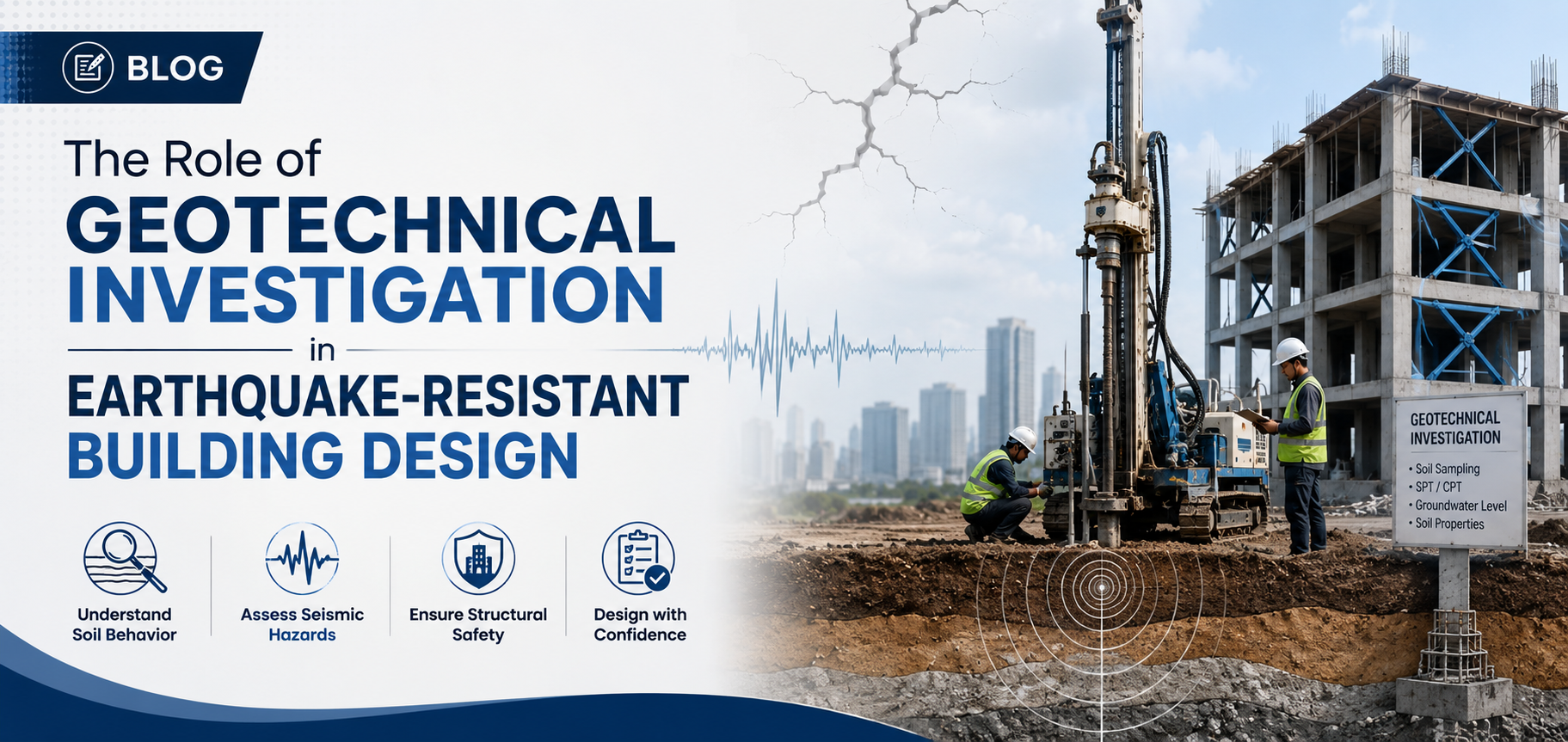
The Role of Geotechnical Investigation in Earthquake-Resistant Building Design
Every year, earthquakes claim thousands of lives and cause billions of dollars in structural damage worldwide. Yet, many of these tragedies could be prevented — not just by better building materials or structural designs, but by understanding the very ground on which buildings stand. This is where geotechnical investigation for earthquake-resistant design becomes absolutely critical.
Geotechnical engineering and earthquake safety are inseparable disciplines. Before a single column is erected or a foundation is poured, engineers must thoroughly analyze the subsurface conditions of the site. This process — known as geotechnical investigation — forms the scientific backbone of every earthquake-resistant building project.
In this comprehensive guide, we explore how geotechnical investigations influence seismic building design, why they are legally and technically mandatory in earthquake-prone regions, and what happens when they are neglected.
What is Geotechnical Investigation?
Geotechnical investigation is a systematic process of evaluating subsurface soil, rock, and groundwater conditions at a construction site. It involves a combination of field testing, laboratory analysis, and engineering judgment to understand how the ground will behave under various loading conditions — including the dynamic forces exerted during an earthquake.
Key components of a geotechnical investigation include:
-
Borehole drilling and soil sampling
-
Standard Penetration Test (SPT)
-
Cone Penetration Test (CPT)
-
Shear wave velocity measurement
-
Groundwater level assessment
-
Laboratory soil classification and strength testing
These tests collectively produce a geotechnical report for earthquake zone construction — a document that guides structural engineers, architects, and project owners in making informed decisions about foundation type, design loads, and risk mitigation strategies.
Why Soil Investigation is Critical for Seismic Design
Soil investigation for seismic design is not merely a technical formality — it is a life-safety requirement. Earthquakes do not destroy buildings directly. Instead, seismic waves travel through the ground and cause the soil to shake, which in turn shakes the building's foundation and superstructure.
The behavior of soil during an earthquake depends on its type, density, moisture content, and layering. Loose, saturated sandy soils, for example, can undergo liquefaction — a phenomenon where the soil temporarily loses its strength and behaves like a liquid. This can cause buildings to tilt, sink, or collapse entirely.
Liquefaction risk assessment in construction is one of the most important outputs of a geotechnical investigation in seismic zones. Engineers analyze the grain size distribution, relative density, and groundwater table depth to assess whether liquefaction is a threat — and if so, recommend ground improvement techniques such as vibro-compaction, stone columns, or deep soil mixing.
Seismic Site Characterization: The Science Behind the Survey
What is seismic site characterization in geotechnical engineering? It is the process of classifying a site based on its ground motion amplification potential during an earthquake. International building codes — including IS 1893 (India), ASCE 7 (USA), and Eurocode 8 — require engineers to assign a "Site Class" to every construction project located in seismic zones.
Site classification is primarily determined by the average shear wave velocity (Vs30) of the top 30 meters of soil. This measurement, obtained through seismic refraction surveys or downhole testing, tells engineers how fast seismic waves travel through the ground — and therefore, how much those waves will be amplified at the surface.
Softer soils amplify ground motion significantly more than hard rock. This is why:
-
Buildings on soft clay experience higher seismic forces than buildings on rock
-
Damage patterns after earthquakes often concentrate in areas with soft, deep soil deposits
-
Site-specific ground response analysis for buildings is essential for accurate structural design
Site investigation for seismic hazard assessment provides the data needed to perform ground response analysis — a numerical simulation that predicts how the soil column at a specific site will respond to earthquake shaking. The results directly influence the seismic design forces used in structural analysis.
Foundation Design for Earthquake Zones
One of the most critical decisions in seismic construction is selecting the best foundation type for earthquake-prone areas. This decision cannot be made without a thorough geotechnical investigation. The soil bearing capacity for earthquake-resistant buildings must account for both static loads (dead and live loads) and dynamic loads (seismic forces).
Common foundation solutions for seismic zones include:
-
Pile Foundations: Used when weak surface soils are present; transfer loads to deeper, competent strata below the liquefiable zone
-
Raft/Mat Foundations: Distribute loads over a larger area, reducing differential settlement during earthquakes
-
Isolated Footings with Tie Beams: Suitable for stiff to medium soils with proper interconnection to prevent differential movement
-
Base-Isolated Foundations: Advanced systems that decouple the building from ground motion using rubber bearings or friction pendulum devices
The geotechnical investigation determines which foundation type is appropriate, what depth is required, and what bearing capacity values should be used in structural design calculations.
Seismic Soil Testing Methods Used by Engineers
Several seismic soil testing methods are employed during geotechnical investigations in earthquake-prone areas. Each method provides specific data that contributes to a complete picture of site conditions:
Standard Penetration Test (SPT)
Measures soil resistance to dynamic penetration. SPT N-values are widely used to assess liquefaction potential and estimate bearing capacity.
Seismic Refraction Survey
A non-invasive surface technique that determines the P-wave and S-wave velocity profiles, helping classify the site seismically.
Multichannel Analysis of Surface Waves (MASW)
Provides a detailed shear wave velocity profile of the subsurface — a key input for site classification and ground response analysis.
Cone Penetration Test (CPT) with Pore Pressure
Offers continuous soil profiling and is particularly effective for identifying loose, liquefiable layers.
Borehole Logging and Sampling
Provides direct soil samples for laboratory testing — including grain size analysis, plasticity tests, and cyclic triaxial tests to assess seismic strength.
Role of Geotechnical Engineers in Disaster-Resistant Construction
The role of the geotechnical engineer in disaster-resistant construction extends far beyond producing a soil report. These professionals act as the critical link between the raw earth and the structures built upon it. Their responsibilities include:
-
Conducting and supervising field investigations
-
Interpreting complex geologic and geotechnical data
-
Performing seismic hazard and liquefaction analyses
-
Recommending ground improvement techniques
-
Advising on foundation type and design parameters
-
Reviewing structural designs for geotechnical compatibility
-
Monitoring construction to ensure compliance with recommendations
How geotechnical investigation helps in earthquake-resistant building goes beyond technical compliance — it saves lives. In countries like Japan, New Zealand, and Chile, rigorous geotechnical standards have demonstrably reduced casualties and structural damage even during major seismic events.
Importance of Soil Testing Before Construction in Seismic Zones
The importance of soil testing before construction in seismic zones cannot be overstated. Building codes worldwide mandate site-specific geotechnical investigations in all seismic zones. In India, IS 1893 (Part 1) divides the country into four seismic zones (II to V), with Zone V being the most hazardous. For construction in Zones III, IV, and V, detailed geotechnical investigations are not optional — they are compulsory.
Skipping or underperforming geotechnical investigations in seismic zones has led to catastrophic consequences. The 2001 Bhuj earthquake in India, the 2010 Haiti earthquake, and the 2011 Christchurch earthquake all exposed the devastating consequences of poor site investigation and inadequate foundation design.
Conversely, buildings that were constructed based on thorough geotechnical reports — with appropriate foundation designs and ground improvements — performed remarkably well under severe seismic loading, protecting the occupants and minimizing damage.
Real-World Application: From Report to Safe Building
Consider a high-rise building project in a seismic zone. Here is how the geotechnical investigation shapes the entire project:
Phase 1 – Preliminary Assessment: Review existing geological maps, seismic history, and regional soil data to plan the investigation scope.
Phase 2 – Field Investigation: Conduct boreholes, SPT testing, and seismic surveys. Collect soil and rock samples for laboratory testing.
Phase 3 – Laboratory Testing: Analyze samples for classification, shear strength, compressibility, and cyclic behavior under seismic loading.
Phase 4 – Seismic Hazard Analysis: Determine design ground motion parameters (peak ground acceleration, spectral accelerations) for the specific site.
Phase 5 – Ground Response Analysis: Model the soil column to assess site amplification and generate a site-specific design spectrum.
Phase 6 – Geotechnical Report: Compile findings, assess liquefaction and landslide risks, and recommend foundation type, depth, and design parameters.
Phase 7 – Foundation Design: Structural engineers use geotechnical parameters to design the foundation system that safely transfers seismic loads to stable ground.
Conclusion
Geotechnical investigation is not merely a preconstruction formality — it is the foundation of earthquake-resistant building design. From seismic soil testing and liquefaction risk assessment to ground response analysis and foundation recommendations, every element of a geotechnical investigation contributes directly to the safety and resilience of the structures we build.
As urbanization continues to expand into seismically active regions, the importance of rigorous site investigation for seismic hazard assessment will only grow. Engineers, developers, and policymakers must recognize that investing in comprehensive geotechnical investigations today is the most cost-effective way to prevent building failures and save lives tomorrow.
Whether you are a property developer, structural engineer, or project manager working in an earthquake-prone area, partnering with an experienced geotechnical investigation service is not a choice — it is a professional and ethical responsibility.
Frequently Asked Questions (FAQs)
Q1: Why is geotechnical investigation important for earthquake-resistant design?
Geotechnical investigation reveals the soil's behavior under seismic loading, identifies hazards like liquefaction, and provides design parameters for earthquake-resistant foundations and structures.
Q2: What is liquefaction and why is it dangerous?
Liquefaction occurs when saturated, loose sandy soil loses its strength during earthquake shaking and behaves like a liquid. It can cause buildings to sink, tilt, or collapse.
Q3: What is the best foundation type for earthquake-prone areas?
The best foundation type depends on site conditions. Pile foundations are often used in areas with soft or liquefiable soils, while raft foundations are suitable for medium to stiff soils. A geotechnical engineer determines the most appropriate solution based on investigation results.
Q4: How does shear wave velocity affect seismic building design?
Shear wave velocity (Vs30) is used to classify the seismic site class of a location. Softer soils with lower Vs30 values amplify earthquake ground motions more, requiring higher design seismic forces.
Q5: Is geotechnical investigation mandatory for all construction in seismic zones?
Yes, in most countries, building codes require geotechnical investigations for structures in seismic zones, especially for critical, tall, or densely occupied buildings.
Popular post

February 08, 2025
Pile Load Testing: Importance, Methods, and Benefits

February 11, 2025
Piling Work Service: The Key to Strong and Stable Foundations

February 18, 2025
What Are Geotechnical Services? A Complete Guide


February 22, 2025
What is a Road Safety Audit & Why is it Important?





April 16, 2025
Types of Material Testing: A Complete Guide for Beginners

February 07, 2026
Top 10 Geotechnical Problems in Construction and Their Solutions
March 31, 2026
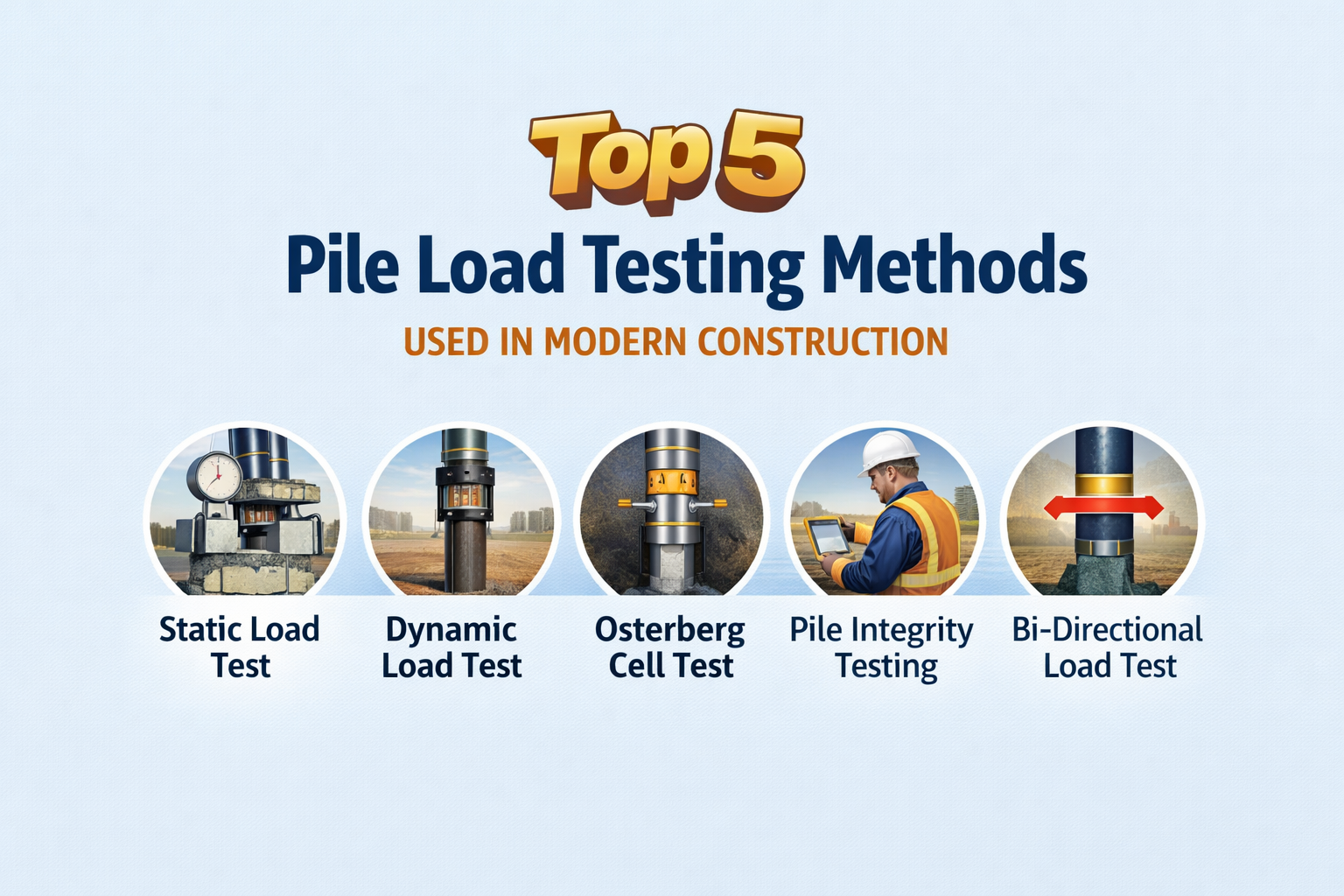
Top 5 Pile Load Testing Methods Used in Modern Construction


June 30, 2026
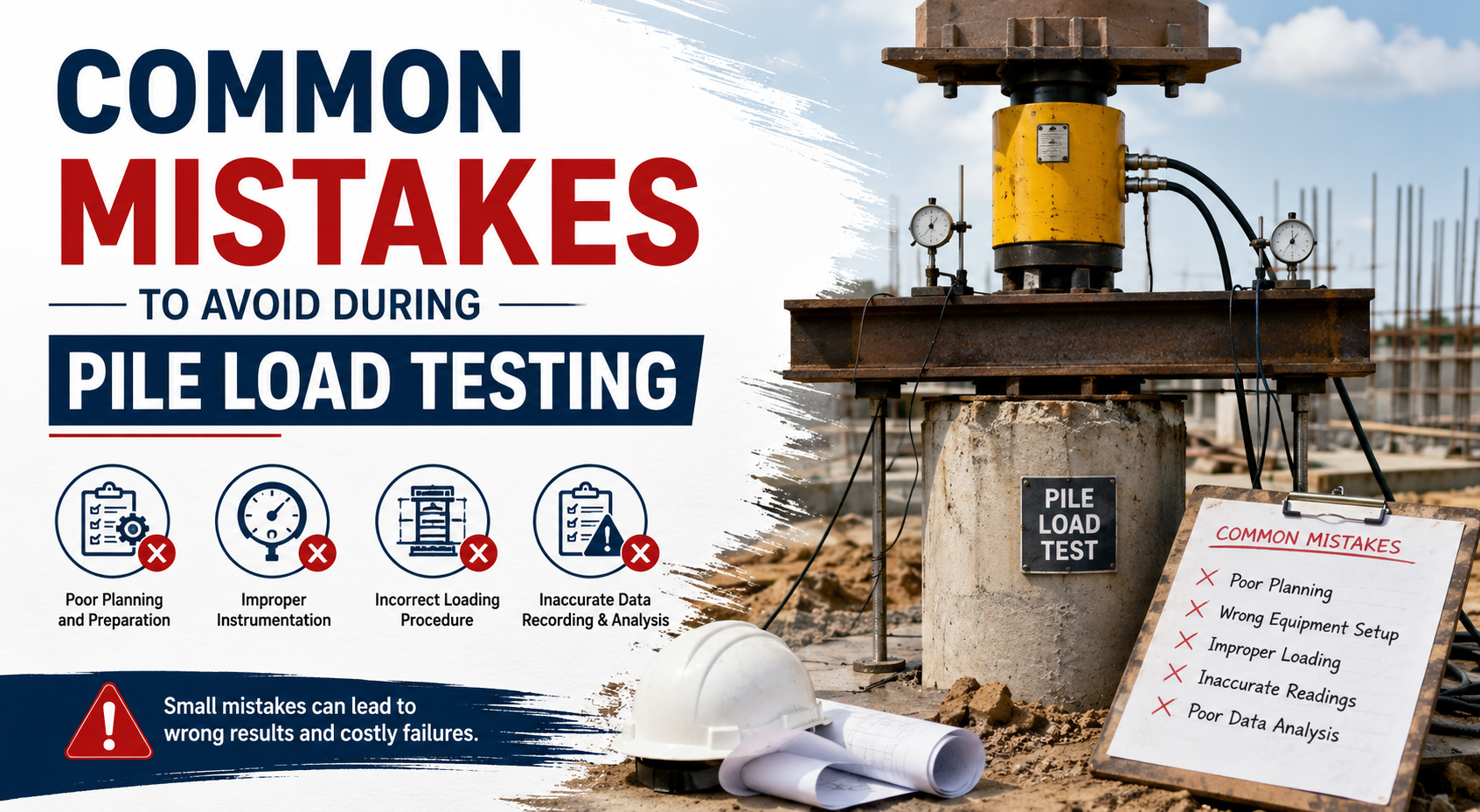
Common Mistakes to Avoid During Pile Load Testing

Need help? Call us Today at+91 7665235528
for inquiries and support. We’re here to assist you.