January 24, 2025

How Geotechnical Engineers Determine Soil Bearing Capacity for Buildings
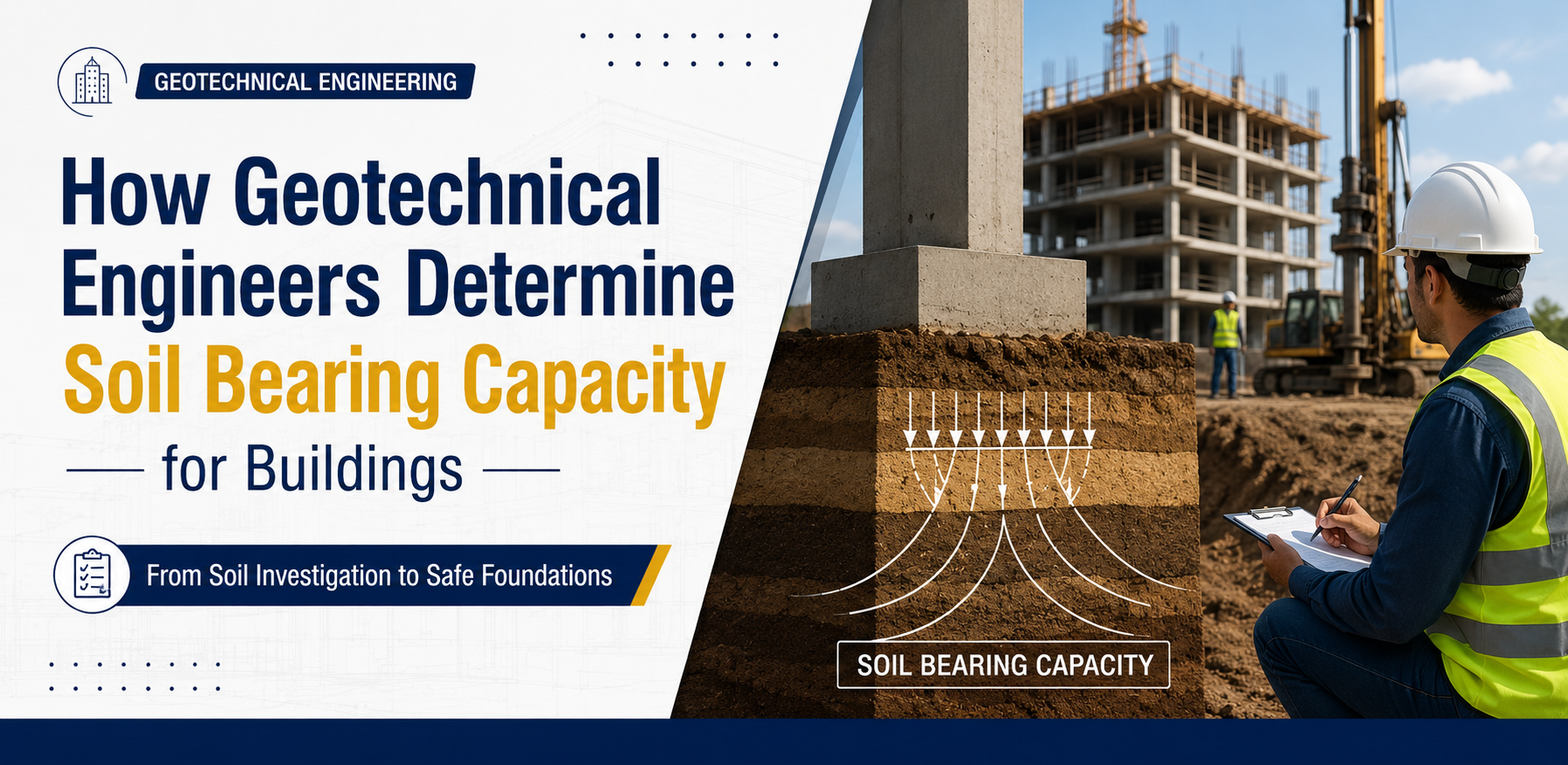
Every safe building starts from the ground up — literally. Before a single brick is laid, geotechnical engineers must answer one critical question: can this soil support the weight of the structure? This is where soil bearing capacity comes into play, and it's one of the most important factors in construction planning.
In this guide, we'll break down everything you need to know about bearing capacity of soil, how it's calculated, why it matters, and what tests are used to determine it — all explained in simple, easy-to-understand language.
What is Soil Bearing Capacity?
Soil bearing capacity refers to the maximum load per unit area that the soil can support without failing or causing excessive settlement. In simple terms, it tells engineers how much weight the ground beneath a building can safely handle before it gives way.
There are three important terms you'll often hear in this context:
-
Ultimate bearing capacity of soil – the maximum load the soil can bear before it completely fails.
-
Safe bearing capacity of soil – the load the soil can support with a margin of safety, used for actual design purposes.
-
Allowable bearing capacity of soil – similar to safe bearing capacity, but it also accounts for acceptable settlement limits.
Understanding these terms helps engineers design foundations that are both safe and cost-effective.
Why Bearing Capacity Matters in Construction
Imagine building a multi-story structure on soil that can't handle the load — the result could be cracked walls, uneven floors, or in worst cases, structural collapse. This is why geotechnical engineering plays such a vital role before any construction begins.
Determining the bearing capacity of soil for building construction helps engineers:
-
Choose the right type of foundation (shallow or deep)
-
Decide the foundation depth and width
-
Estimate how much settlement the building might experience
-
Prevent future structural damage and costly repairs
Skipping this step is one of the most common — and dangerous — mistakes in construction projects.
How Geotechnical Engineers Determine Soil Bearing Capacity
Now let's get to the main question: how exactly do engineers find out the bearing capacity of soil? Here are the most common methods used in the field.
1. Geotechnical Investigation for Foundation Design
The process starts with a detailed geotechnical investigation for foundation design. Engineers visit the site, collect soil samples from various depths using boring machines, and study the soil layers, water table level, and overall ground conditions. This investigation forms the foundation (literally) for all further calculations.
2. Standard Penetration Test (SPT) for Bearing Capacity
One of the most widely used field tests is the Standard Penetration Test (SPT) for bearing capacity. In this test, a hammer drops a known weight onto a sampling tube driven into the soil. The number of blows required to penetrate the soil at fixed intervals gives engineers an "N-value," which is directly related to soil strength and bearing capacity.
SPT is popular because it's quick, cost-effective, and works well for most soil types, especially sandy and gravelly soils.
3. Plate Load Test for Bearing Capacity
The plate load test for bearing capacity is another common field method. A steel plate is placed on the ground at the foundation level, and gradually increasing loads are applied to it. Engineers measure how much the plate settles under each load. This data helps determine the actual bearing capacity of the soil at that specific site, especially useful for shallow foundations.
4. Terzaghi Bearing Capacity Theory
When it comes to calculations, the Terzaghi bearing capacity theory is one of the most widely referenced methods in geotechnical engineering. Developed by Karl Terzaghi, this theory provides a mathematical formula to estimate the ultimate bearing capacity based on soil properties like cohesion, friction angle, and unit weight, along with foundation dimensions.
The basic Terzaghi formula considers three main factors:
-
Cohesion of soil
-
Surcharge load (weight of soil above the foundation)
-
Width of the foundation
Engineers still rely on this theory as a starting point, even though modern methods have added refinements over the years.
5. Soil Bearing Capacity Calculation Formula
Once field data is collected, engineers use a soil bearing capacity calculation formula to process the numbers. While formulas vary slightly depending on soil type and foundation design, the general approach combines lab test results (like cohesion and friction angle) with field test data (like SPT values) to arrive at a reliable bearing capacity figure.
This calculated value is then used to design the foundation size, depth, and reinforcement needed for the structure.
Bearing Capacity of Different Types of Soil
Not all soils behave the same way. The bearing capacity of different types of soil can vary drastically:
-
Rocky soil – Highest bearing capacity, ideal for heavy structures
-
Gravel and sand (dense) – Good bearing capacity, commonly suitable for most buildings
-
Sandy soil (loose) – Moderate bearing capacity, may require compaction
-
Clay soil – Bearing capacity depends heavily on moisture content; can be weak when wet
-
Soft or organic soil (like peat) – Very low bearing capacity, often requires soil improvement or deep foundations
This is exactly why a soil bearing capacity test for house construction is just as important for small residential projects as it is for large commercial buildings.
Factors Affecting Bearing Capacity of Soil
Several factors affecting bearing capacity of soil need to be considered during investigation:
-
Soil type and composition – Clay, sand, silt, and rock all behave differently under load.
-
Moisture content – Water-saturated soil generally has lower bearing capacity.
-
Depth of foundation – Deeper foundations often reach stronger soil layers.
-
Water table level – A high water table can significantly reduce soil strength.
-
Soil density and compaction – Denser soil generally supports more load.
-
Presence of voids or weak layers – Hidden weak pockets can cause uneven settlement.
Understanding these factors helps engineers make accurate predictions and avoid costly design errors.
Why You Should Hire Professional Geotechnical Investigation Services
Determining bearing capacity shouldn't be guessed or skipped to save time and money. Professional Geotechnical Investigation Services ensure that:
-
Accurate soil data is collected using proper testing methods
-
Calculations follow recognized engineering standards
-
Foundation design matches actual ground conditions
-
Risks of structural failure or future repairs are minimized
If you're searching for a soil testing company , make sure they have experience with both field tests (SPT, plate load test) and proper lab analysis. The bearing capacity test cost is a small investment compared to the potential cost of structural damage down the line.
Frequently Asked Questions
Q1. What is a good bearing capacity for soil? A good bearing capacity generally ranges from 100 kN/m² to over 600 kN/m² depending on soil type, with rocky or dense gravel soils offering the highest values.
Q2. How is bearing capacity of soil calculated? It's calculated using field tests (like SPT or plate load test) combined with theoretical formulas such as the Terzaghi bearing capacity theory, factoring in soil cohesion, friction angle, and foundation dimensions.
Q3. Why is soil bearing capacity important before construction? It determines the type and size of foundation needed, helping prevent structural failure, uneven settlement, and costly future repairs.
Q4. What test is commonly used to check bearing capacity? The Standard Penetration Test (SPT) and plate load test are the two most commonly used methods to determine soil bearing capacity on construction sites.
Final Thoughts
Soil bearing capacity might not be the most glamorous part of construction, but it's undoubtedly one of the most important. From small residential homes to massive high-rise buildings, every safe structure depends on accurate geotechnical investigation and proper bearing capacity calculations.
If you're planning a construction project, don't skip this step. Investing in professional Geotechnical Investigation Services today can save you from major structural headaches tomorrow.
Popular post

February 08, 2025
Pile Load Testing: Importance, Methods, and Benefits

February 11, 2025
Piling Work Service: The Key to Strong and Stable Foundations

February 18, 2025
What Are Geotechnical Services? A Complete Guide

February 22, 2025
What is a Road Safety Audit & Why is it Important?




April 16, 2025
Types of Material Testing: A Complete Guide for Beginners


February 07, 2026
Top 10 Geotechnical Problems in Construction and Their Solutions
March 31, 2026
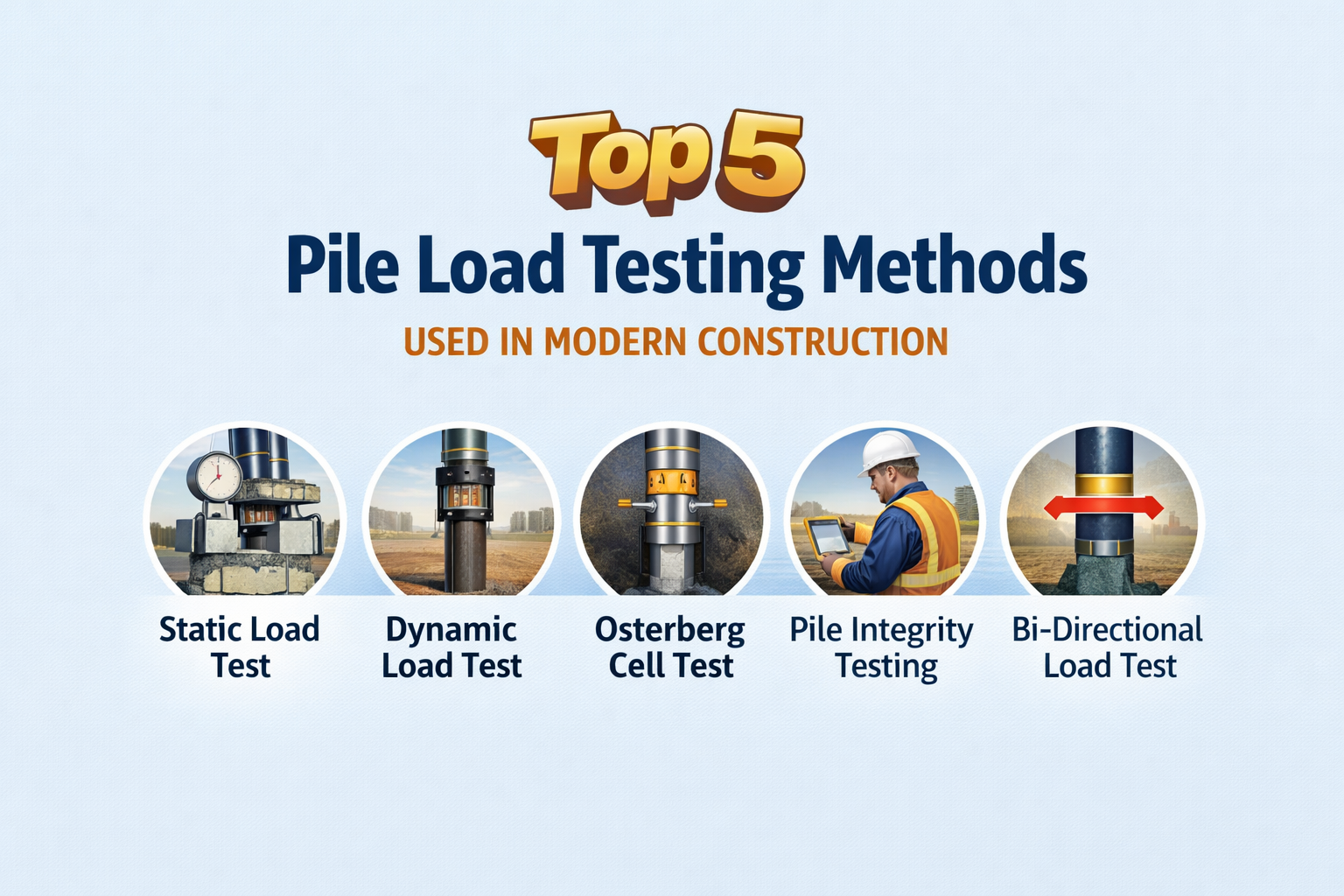
Top 5 Pile Load Testing Methods Used in Modern Construction

June 30, 2026
Common Mistakes to Avoid During Pile Load Testing
Need help? Call us Today at+91 7665235528
for inquiries and support. We’re here to assist you.